Vintage and Antique Gifts
Vintage 1997 NFL Kansas City Chiefs Fingernail Tattoos - Play-By-Play San Antonio - Sealed Football Novelty Package Card 🍺
Vintage 1997 NFL Kansas City Chiefs Fingernail Tattoos - Play-By-Play San Antonio - Sealed Football Novelty Package Card 🍺
Couldn't load pickup availability
🏈 Remember Painting Your Nails in Team Colors Before the Big Game?
There was a stretch in the 1990s when NFL fandom didn't stop at your jersey or your foam finger — it went all the way down to your fingertips. Long before nail art became its own industry, football fans were pressing tiny team logos onto their nails before kickoff, and this little card is a genuine survivor of that moment: a sealed sheet of Kansas City Chiefs Fingernail Tattoos, never opened, never used, waiting more than a quarter century for someone to finally peel back that protective sheet.
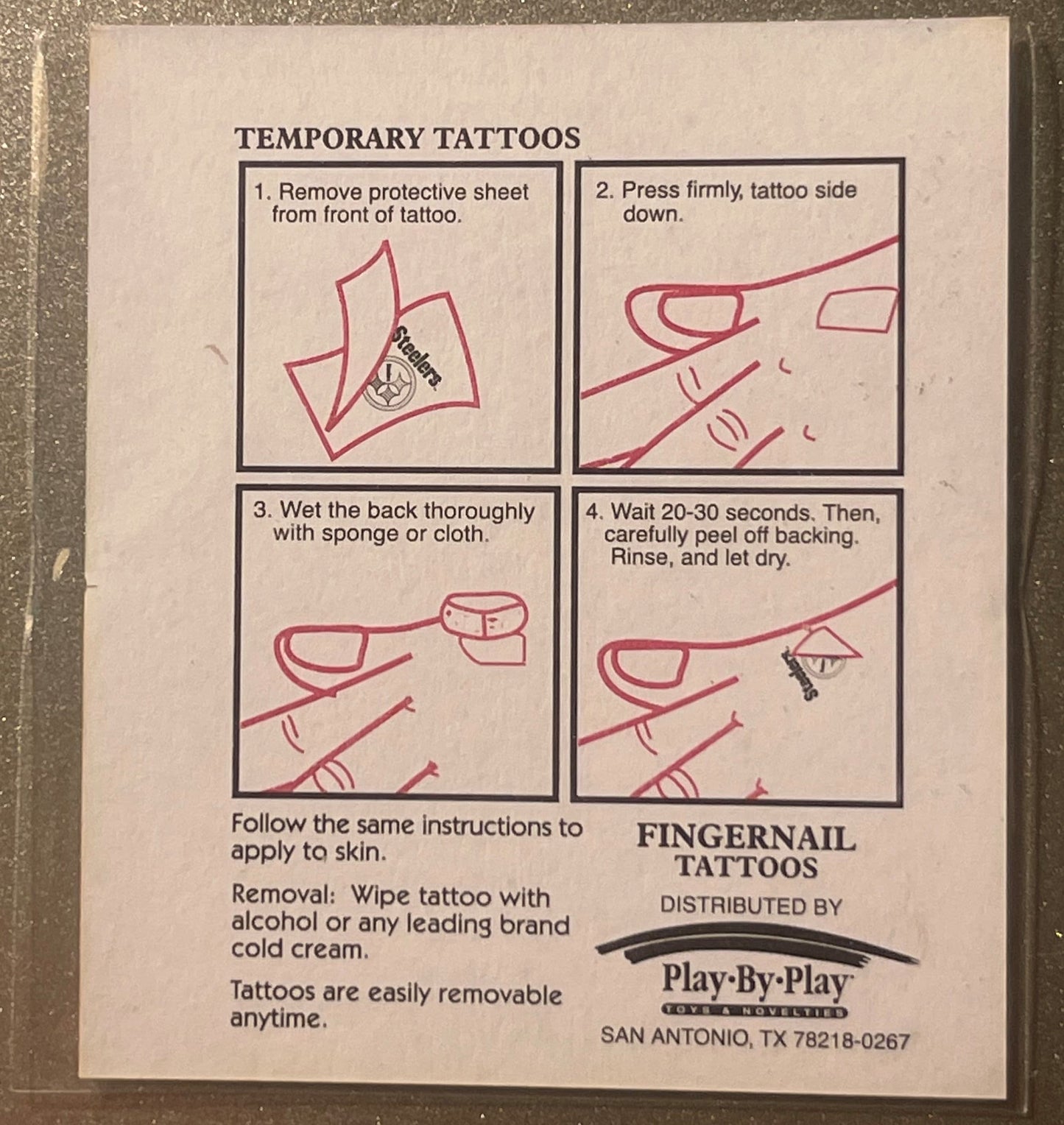
This is an officially licensed NFL / Kansas City Chiefs novelty item produced by Play-By-Play Toys & Novelties of San Antonio, Texas, carrying the copyright line "© 1997 NFL Properties, Inc. All rights reserved" — the confirmed year this piece was produced. The card measures 2.5 x 2.5 inches (about 6.4 x 6.4 cm), a small, nearly-square sheet whose top half is a full-color offset-lithographed illustration: the star-spangled NFL shield in navy, red, and white sits over a sunlit stadium scene of green turf, yard lines, and pennant flags, with a white bullet-point panel promising the tattoos are "Easy to apply," "Easy to remove," "Waterproof," "Lasts for days," and "Safe & non-toxic." Below that, bold yellow lettering outlined in black spells out FINGERNAIL TATTOOS across the green field art, with "MADE IN TAIWAN" and a child-safety note printed beneath. The lower half of the card, on tan/cream stock, holds ten individual die-cut tattoo images arranged in three rows — each one the Chiefs' familiar arrowhead shape in a black outline, with the interlocking red "KC" monogram at its center. A companion instruction card, included with the package, walks through application in four illustrated steps using red line art, and closes with the distributor credit: "FINGERNAIL TATTOOS, DISTRIBUTED BY Play-By-Play TOYS & NOVELTIES, SAN ANTONIO, TX 78218-0267."
This piece is offered as New Old Stock (NOS) — meaning it was never sold through to a fan back in the 1997 season, never opened, and has simply been sitting, sealed and unused, since it left the factory.
🏹 The Arrowhead on Your Nail
The Kansas City Chiefs have carried the arrowhead as their emblem since the franchise moved to Missouri in the early 1960s, and by the time this card was printed in 1997, that red-and-white arrowhead with "KC" lettered across it was already one of the most recognized marks in professional football — instantly readable even shrunk down to fingernail size. That's really the appeal of a novelty like this one: the NFL licensing machine of the 1990s understood that a team's identity could be miniaturized onto almost anything, from bumper stickers to lunch boxes to, in this case, a sheet of ten tiny adhesive tattoos meant to turn a single afternoon of tailgating into a full-body show of team spirit.
What makes a piece like this resonate today goes beyond nostalgia for the design — it's the arc of the franchise itself. A Chiefs fan in 1997 was cheering for a proud but long-frustrated team; the club's last championship run dated back decades. Fast-forward to today's NFL, and the Chiefs sit among the league's most dominant modern dynasties, with a run of championship seasons that has made that same red arrowhead more visible than ever, on everything from stadium jumbotrons to a new generation of fingernail decals sold at every drugstore checkout counter. Owning a genuine 1997 example — from the lean years before the current era of Chiefs football — gives this little card a "before it was cool again" charm that current-production items simply can't replicate.
🧑🍳 From a Havana Kitchen to a Toy Empire
The company behind this card has one of the more remarkable origin stories in the American toy and novelty business. Play-By-Play Toys & Novelties, Inc. traces back to founder Arturo Torres, who left Cuba for the United States in 1961 with, as company histories tell it, dreams of becoming a cowboy — and instead found himself washing dishes at a Pizza Hut in Texas. From that kitchen, Torres built one of the largest licensed plush-toy and novelty companies in the country. Corporate registry records show the San Antonio entity was incorporated in 1986 and began trading under the "Play by Play Toys & Novelties, Inc." name in January 1992, after previously operating as "TMI, Inc." The company's own later history places its practical start in San Antonio around 1990, when its earliest licensing wins were Harley-Davidson and Coca-Cola — brand names chosen deliberately as the strategy Torres pursued from the very beginning: chase the biggest, most recognizable licenses in the marketplace.
That strategy paid off. By 1997 — the very year this Chiefs card was printed — Play-By-Play was a public company trading on NASDAQ under the ticker PBYB, employing roughly 620 people and posting sales north of $74 million, headquartered at 4400 Tejasco in San Antonio, Texas 78218 — the exact zip code printed right on this card's distributor credit. Its licensing roster by then read like a Saturday-morning cartoon lineup crossed with a sports memorabilia counter: Disney's Mickey Mouse and Winnie the Pooh, Warner Bros.' Bugs Bunny, Tweety, Sylvester, the Tasmanian Devil, and the Animaniacs, Marvel's Spider-Man and Wolverine, Batman, plus professional sports team logos under the NFL license that produced this very tattoo sheet. The company's biggest single move came in 1996, when it acquired Ace Novelty Co., financed through a $65 million credit facility arranged with Chemical Bank as lead agent, alongside Heller Financial and Texas Commerce Bank — a deal that, according to the company's own executives at the time, made Play-By-Play the largest supplier of stuffed toys and novelties in the United States. CFO Joe Guerra told trade press covering the deal that the company intended to keep the Ace name running as its own subsidiary, noting "there is quite a bit of value in the Ace name and reputation." Play-By-Play followed that acquisition with the purchase of TLC Gift Company in November 1996, and by 1998 it was expanding into Europe, signing a UK Disney plush distribution agreement reportedly worth $5 million in its first year alone.
⚖️ The Toy That Went to Federal Court
Play-By-Play's history includes an unexpected chapter in American intellectual-property law. In the case Nadel v. Play-By-Play Toys & Novelties, Inc., decided by the Second Circuit Court of Appeals in 2000, toy inventor Craig P. Nadel alleged the company used his idea for a spinning, sound-emitting plush toy — reportedly disclosed to company executive Neil Wasserman — without ever compensating him, in a dispute centered on a licensed Taz the Tasmanian Devil plush toy made under Play-By-Play's Warner Bros. license. The ruling remains a frequently cited authority in intellectual-property casebooks today, on the standards for "idea submission" claims in the toy industry — a strange and lasting footnote tying this modest San Antonio novelty maker to U.S. legal history, decades after the fact.
📉 When the Whistle Blew
The empire Torres built didn't last into the new century. On May 1, 2001, Play-By-Play Toys & Novelties received notice that NASDAQ was delisting its shares from the National Market after the company failed to meet continued-listing requirements, and trading shifted to the OTC Bulletin Board. By 2002, according to the company's own successor history, internal restructuring moved its headquarters to Spain. The original Texas corporation was formally dissolved for tax forfeiture on December 15, 2006 — the very same year that Spanish toy manufacturer FAMOSA (Fábricas Agrupadas de Muñecas de Onil) acquired both Play by Play and fellow toy maker Feber, folding the brand into its own international operations. Today, the Play by Play name survives only as a European plush-toy label, part of the Famosa–Giochi Preziosi group since 2019 — the San Antonio company that once employed hundreds of people, held some of the biggest licenses in American pop culture, and produced this very Chiefs tattoo sheet, no longer exists as an independent American business. That makes surviving, unopened pieces like this one a genuine artifact of a company whose American chapter has fully closed.
🕵️ The Steelers Slip-Up
One of the most telling details on this card isn't even about the Chiefs at all — it's on the companion instruction sheet. The four-step "how to apply" diagram uses a sample tattoo labeled "Steelers" to illustrate the process, even though the sheet it's packaged with is entirely Kansas City Chiefs artwork. That mismatch is a small but genuine window into how licensed novelty production actually worked in this era: rather than print a unique instruction sheet for all thirty-some NFL franchises, Play-By-Play (or its printer) simply reused a single generic instruction card across the whole team lineup, illustrated once with whichever team happened to be handy at the print shop. It's a detail easy to overlook, but it's exactly the kind of production quirk that collectors of licensed sports ephemera love to spot — proof this card came from a real assembly-line run of team variations, not a one-off.
🌴 A Florida Rescue
Every surviving piece like this has a road it traveled to get here, and this one's road ran through Florida, where it was pulled from a stash of old, forgotten inventory before it could be lost or thrown out. Family lore passed down from that find holds that this fingernail tattoo promotion was only ever made for twelve different NFL teams back in 1997, and that only a small handful of those twelve have ever resurfaced on the collector market since — this Chiefs sheet among them. Whether that number holds exactly at twelve, it's a detail worth preserving here in its own words, because it's exactly the kind of oral history that never gets written down in a corporate filing, and it may be the only place it survives at all.
🖼️ Display Ideas
- 🖼️ Slip it into a top-loader or small card sleeve and frame it alongside other 1990s Chiefs memorabilia for a shadow-box tribute.
- 🏈 Set it out on a game-day snack table as a conversation piece for fellow fans before kickoff.
- 📓 Mount it in a sports scrapbook or memory album next to ticket stubs and programs from Chiefs seasons past.
- 🏠 Add it to a man-cave or home office shelf as a small, colorful piece of licensed sports history.
- 🎁 Pair it with other vintage NFL novelties as a themed gift for a die-hard Chiefs collector.
- 🏆 Display it near current Chiefs championship memorabilia to show off just how far the franchise has come since 1997.
🎁 Who Collects These
This little card draws interest from several different directions at once. Kansas City Chiefs superfans and season-ticket-holding families collect anything bearing the arrowhead, especially pieces that predate the team's modern championship run. NFL memorabilia collectors more broadly seek out licensed novelties from the 1990s — an era before online shopping, when trips to the sporting goods counter or five-and-dime were how fans got their gear. Toy and novelty-industry historians, particularly those tracking the rise and fall of licensed American toy manufacturers, value anything tied to Play-By-Play, given how completely the company's American operations have since vanished. And a smaller, more surprising crowd — students and enthusiasts of intellectual-property law — recognize the Play-By-Play name from the Nadel case and enjoy owning a tangible piece of a company that shows up in their casebooks. For all of them, a sealed, unused sheet like this one holds particular appeal, since it represents the item exactly as it left the factory in 1997.
❓ FAQ
What exactly are NFL Fingernail Tattoos?
They're licensed temporary adhesive decals, sized for fingernails, produced under NFL Properties' license and distributed by Play-By-Play Toys & Novelties. The included instruction card describes wetting the back and pressing the tattoo side down, the same basic method used for skin-safe temporary tattoos of the era.
How old is this piece?
The card itself carries the printed line "© 1997 NFL Properties, Inc. All rights reserved," confirming 1997 as its production year.
Who made this?
Play-By-Play Toys & Novelties, Inc., a licensed toy and novelty manufacturer headquartered in San Antonio, Texas, distributed the piece; the card notes it was "MADE IN TAIWAN."
Why does the instruction sheet show a Pittsburgh Steelers logo instead of the Chiefs?
The instruction card was a generic, reusable insert included across different NFL team packages — this sheet's Chiefs tattoos are on the front card.
🔎 More From The Vintage & Antique Gifts Archive
Share